González




LA FUERZA DEL SOL / THE STRENGTH OF THE SUN
12.2.26 - 22.3.26 Stoa Gallery - Helsinki, Finland
Exhibition curated and text written by Sebastián González and Luis Bustamante
Esta muestra propone una lectura visual del Carnaval de Arica Con la Fuerza del Sol o Inti Ch'amampi, como un territorio expandido de significados, donde confluyen historia, geopolítica y saberes corporales.
El proyecto —cruzado por la fotografía y la pintura— intenta comprender el carnaval no solo como celebración popular, sino como un acto de resistencia simbólica que articula memoria, espiritualidad y estética en la frontera norte de Chile.
La propuesta curatorial nace desde la observación atenta de los cuerpos en movimiento, los trajes como relatos textiles y el paisaje como fondo vivo de la manifestación.
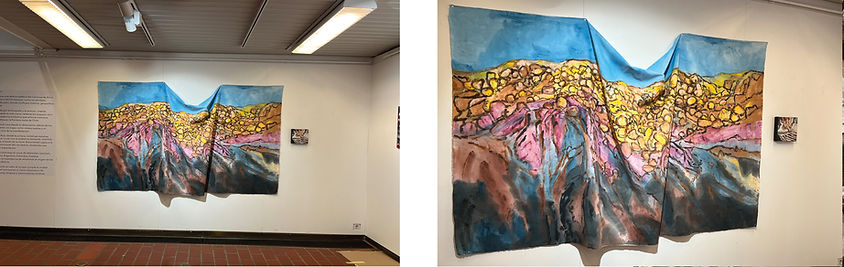
Sebastián González Ruiz, desde la pintura, construye escenas donde la geografía se funde con la anatomía danzante, mientras que Luis Bustamante, a través de su lente documental, captura la intensidad visual y emocional del rito festivo, revelando una realidad más allá del espectáculo.
Esta colaboración se sitúa bajo el cruce de diferentes naciones, entre ellas, Chile, Perú, Argentina, Colombia, Pueblos Afrodescendientes y la importancia de reconocer el origen de las danzas en el caso de Bolivia.
El proyecto busca poner en valor el rol que cumple la ciudad desértica de Arica y el carnaval en sí, como dispositivo de encuentro entre culturas, lenguas y cosmovisiones andinas.
__________
This exhibition proposes a visual reading of the Carnival of Arica “With the Strength of the Sun” or Inti Ch’amampi as an expanded territory of meanings, where history, geopolitics, and embodied knowledge converge.
The project — shaped through photography and painting — seeks to understand the carnival not only as a popular celebration, but as an act of symbolic resistance that brings together memory, spirituality, and aesthetics in the northern border region of Chile.
The curatorial proposal emerges from careful observation of bodies in motion, costumes as textile narratives, and the landscape as a living backdrop to the manifestation.
Sebastián González Ruiz, through painting, constructs scenes where geography merges with dancing anatomy, while Luis Bustamante, through his documentary lens, captures the visual and emotional intensity of the festive rite, revealing a reality beyond spectacle.
This collaboration is situated at the crossroads of different nations — including Chile, Peru, Argentina, Colombia, Afro-descendant communities — and emphasizes the importance of recognizing the origins of the dances, particularly in the case of Bolivia.
The project aims to highlight the role of the desert city of Arica and the carnival itself as a platform for encounter among cultures, languages, and Andean worldviews.


NOTAS PARA UN TERRITORIO / NOTES FOR A TERRITORY
11.1.26 - 31.3.26 Espacio 330, Santiago de Chile.
Exhibition curated and text written by Verónica Tham Testa
La obra de Sebastián González se despliega en la abundancia. Las numerosas telas que se acumulan en su taller dan cuenta de un proceso creativo fecundo, insistente, atravesado por la necesidad de volver una y otra vez sobre un mismo paisaje. No como repetición literal, sino como ejercicio de memoria: cada pintura reconfigura lo anterior, lo desplaza, lo transforma.
El trazo opera aquí como memoria construida desde el cuerpo. Las imágenes poseen densidad y textura, y funcionan como ejercicios de traducción de una forma particular de percibir el entorno. El paisaje es entendido como algo dinámico, movible, que se tensiona en su reiteración. Así como un recuerdo o una anécdota narrada sucesivas veces se transforma en otra cosa, las múltiples variaciones de tonos, matices, luces e intensidades van configurando un territorio abierto a su lectura.
A través de la huella que deja el pincel sobre la tela -hendiduras, manchas, espesores- aparece la mano de quien construye y reconstruye en la repetición. La fisicidad de la pintura se vuelve central: no solo como soporte, sino como presencia material y corporal. La superficie pictórica actúa como un cuerpo que registra densidad, fluidez y profundidad. Este espesor y su intención de movimiento constituyen una deriva, un desplazamiento constante entre forma y percepción.
El recuerdo, entendido como repetición, se manifiesta en paisajes fragmentados. Los ocres, la tierra, lo seco: la aridez de la cordillera y de los cerros de la zona central en verano. Un espacio inhóspito y, al mismo tiempo, un hogar. En este territorio aparece la fábrica como hito, como interrupción y entrada. No se trata únicamente de insistir en el recuerdo, sino de construir una ficción: una arquitectura metálica que se reconfigura como orgánica, que puede estar en construcción o en decadencia, suspendida, detenida, capturada como un fragmento de la acción humana.
Estas estructuras industriales no se presentan como un paisaje naturalizado, sino como una declaración de lo que se corroe o de lo que aún está en proyecto. No conforman un círculo cerrado, sino un viaje. Desde un ejercicio sensorial de retención del paisaje -la montaña, el horizonte, sus características percibidas desde la experiencia del cuerpo- se produce una disrupción en la arquitectura industrial. La fábrica aparece como eco de una época: un reflejo precario, grandilocuente e inexacto de lo que significa producir, de lo que se entiende por progreso, de una idea de lo masculino que también puede estar en construcción y ser revisada desde un presente desarraigado y desencarnado.
Trabajar directamente sobre la tela, con el pincel y la pintura, se vuelve un ejercicio compulsivo de captura: de memoria, de experiencia, de una relación arraigada con la tierra, el paisaje y las proporciones entre el cuerpo y su entorno. No se trata de observar a distancia, sino de sumergirse en un paisaje pastoso, terroso, ocre y marrón, del cual emerge la industria: el fierro, lo abandonado, el ciclo de lo construido.
El resultado es un paisaje imaginario. Una travesía, una cartografía de la memoria que se construye como juego y como búsqueda. Las fábricas aparecen entonces como organismos esqueléticos en suspensión. La obra conduce una ambigüedad que se completa con el observador: narraciones que no están cerradas, espacios sin nombre para no determinarlos, vacíos que permiten una lectura autónoma e intuitiva. Olvido, memoria y archivo se entrelazan. La pintura funciona como archivo y como documento de lo ficticio, entendiendo que en ella habitan también elementos de lo real.
Pintar, buscar y proyectar dentro de la ambigüedad abre un espacio de libertad. La obra se entrega a quien observa para que la reconstruya, para que proyecte su propia memoria. El paisaje se recompone desde la mirada del otro, y esa proyección también permanece en construcción. Conectar con la memoria a través de la pintura, desde su materialidad y su proceso orgánico, es finalmente una invitación: un territorio abierto que se activa en el encuentro entre obra y observador.
__________
Sebastián González’s work unfolds in abundance. The numerous canvases that accumulate in his studio attest to a fertile and insistent creative process, driven by the need to return again and again to the same landscape. Not as literal repetition, but as an exercise in memory: each painting reconfigures what came before, displaces it, transforms it.
Here, the line operates as a memory constructed from the body. The images possess density and texture, functioning as exercises in translating a particular way of perceiving the environment. The landscape is understood as something dynamic, mobile, tensioned through its reiteration. Just as a memory or an anecdote narrated successive times becomes something else, the multiple variations of tones, nuances, lights, and intensities gradually configure a territory open to interpretation.
Through the imprint left by the brush on the canvas—grooves, stains, thicknesses—the hand of the one who constructs and reconstructs through repetition emerges. The physicality of painting becomes central: not only as a support, but as a material and bodily presence. The pictorial surface acts as a body that records density, fluidity, and depth. This thickness and its intention of movement constitute a drift, a constant displacement between form and perception.
Memory, understood as repetition, manifests itself in fragmented landscapes. Ochres, earth, dryness: the aridity of the Andes and the hills of Chile’s central zone in summer. A hostile space and, at the same time, a home. Within this territory, the factory appears as a landmark, as interruption and entry point. It is not merely a matter of insisting on memory, but of constructing a fiction: a metallic architecture that reconfigures itself as organic, that may be under construction or in decay, suspended, halted, captured as a fragment of human action.
These industrial structures are not presented as a naturalized landscape, but as a declaration of what corrodes or what is still in project. They do not form a closed circle, but rather a journey. From a sensory exercise of retaining the landscape—the mountain, the horizon, their characteristics perceived through bodily experience—a disruption occurs within industrial architecture. The factory appears as the echo of an era: a precarious, grandiloquent, and inexact reflection of what it means to produce, of what is understood as progress, of an idea of masculinity that may also be under construction and subject to revision from a present that feels uprooted and disembodied.
Working directly on the canvas, with brush and paint, becomes a compulsive exercise in capture: of memory, of experience, of a rooted relationship with the earth, the landscape, and the proportions between the body and its surroundings. It is not about observing from a distance, but about immersing oneself in a pasty, earthy, ochre, and brown landscape, from which industry emerges: iron, abandonment, the cycle of what has been built.
The result is an imaginary landscape. A journey, a cartography of memory constructed as both play and search.
Factories then appear as skeletal organisms in suspension. The work carries an ambiguity completed by the observer: narratives that are not closed, spaces without names so as not to determine them, voids that allow for an autonomous and intuitive reading. Forgetting, memory, and archive intertwine. Painting functions as archive and as document of the fictitious, understanding that elements of the real also inhabit it.
To paint, to search, and to project within ambiguity opens a space of freedom. The work is given to the viewer so that it may be reconstructed, so that one may project one’s own memory. The landscape is recomposed through the gaze of the other, and that projection also remains under construction. To connect with memory through painting, from its materiality and its organic process, is ultimately an invitation: an open territory activated in the encounter between work and observer.